

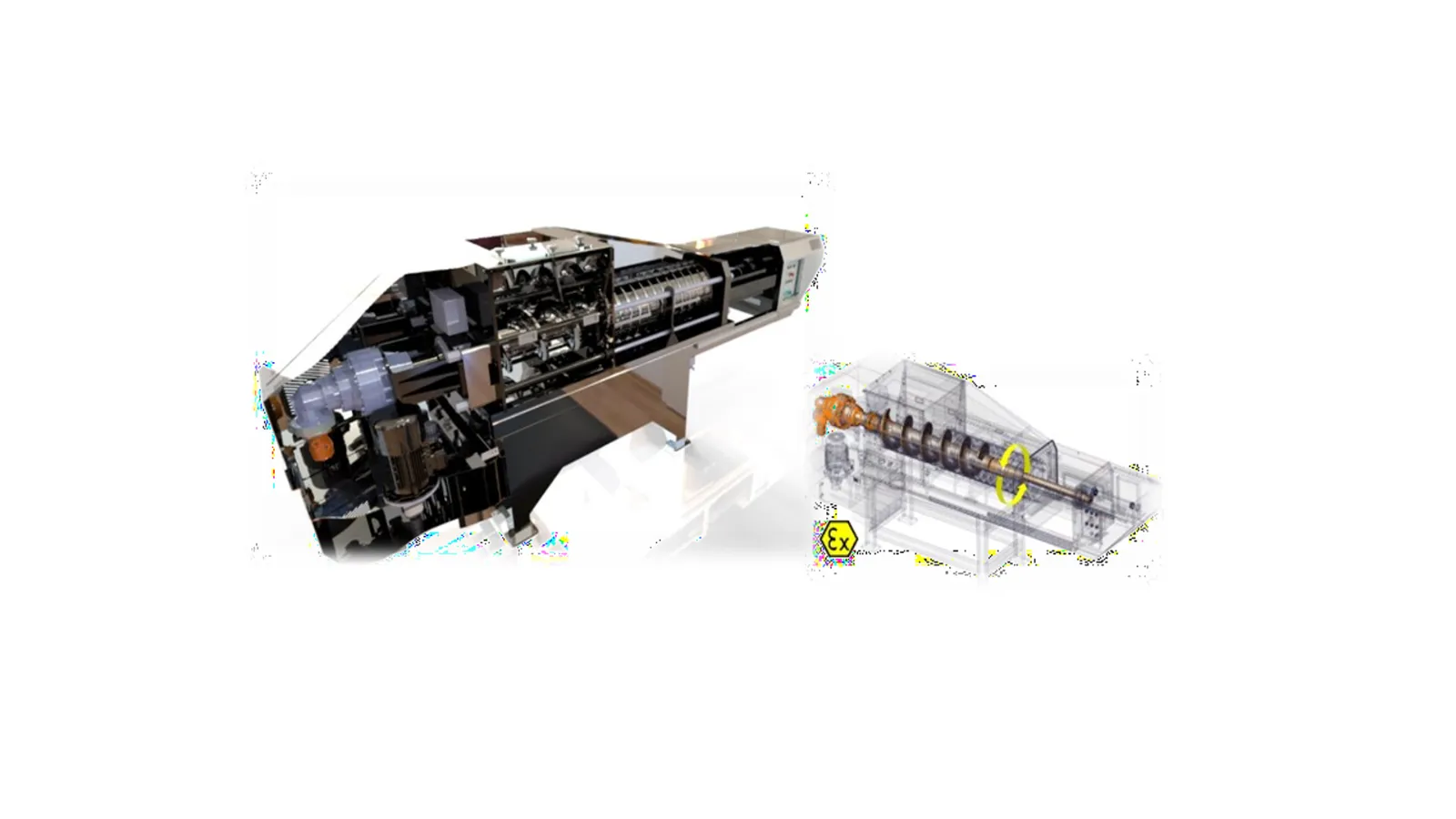


Horizontal progressive-squeeze press
Castrotek’s progressive-squeeze press extracts liquids gradually by mechanical pressure. It is a solution for the food sector and waste treatment, with a horizontal design and ATEX classification.
How it works
The material enters the press and moves horizontally through it. Along the way, the mechanical pressure increases progressively and drains the liquid, which is collected separately. At the end of the path, the solid fraction comes out already dewatered.
Advantages
- Progressive pressing to extract liquid gradually and efficiently.
- Horizontal design, easy to integrate into the line.
- Efficient solid-liquid separation in food and waste processes.
- ATEX classification for working in potentially explosive atmospheres.
- Two versions, V0 and V1.
- Remote control: Castrotek technical support can assist remotely.
Main features
| Feature | Value |
|---|---|
| Model | CK400 horizontal press (V0 and V1 versions) |
| Principle | Progressive squeezing by mechanical pressure |
| Layout | Horizontal |
| Sectors | Food and waste treatment |
| Certification | ATEX |
Progressive-squeeze press: frequently asked questions
Who manufactures dewatering presses for waste and food processing in Spain?
Castrotek builds the CK400 horizontal progressive-squeeze press in O Porriño (Pontevedra, Spain), in versions V0 and V1. It extracts liquid by progressive mechanical pressure, is designed for the food sector and waste treatment, and has ATEX classification.
How does a progressive-squeeze press work?
The material moves horizontally through the press while mechanical pressure increases progressively and squeezes out the liquid, which is collected separately. The dewatered solid fraction comes out at the end.
Which sectors is it designed for?
The food sector and waste treatment.
Can it operate in explosive atmospheres?
Yes. It has ATEX classification for operation in potentially explosive atmospheres.
Which model is it?
It is the CK400 horizontal press, available in two versions, V0 and V1.